Iron fertilization
Dissolved iron (often iron sulfate) into surface waters → phytoplankton blooms → some organic carbon / dead cells sink. Goal discussed: carbon sequestration. Major trials are not documented as mass fish kills.
Science desk · Ocean ecology literacy
Two very different stories get mashed together in casual talk about “putting metal in the ocean.” One is ocean iron fertilization — dissolving iron salts in surface waters to grow phytoplankton, with some biomass sinking toward the seafloor. The other is deep-sea mining and metal-rich particle plumes — grinding or discharging sulphide/nodule/sediment waste into seawater. This page keeps them separate: what was released, what sank, what died in published evidence, and what is still uncertain. Pair with ore mining & lithium and atmosphere (CO2 / climate context for why iron experiments were proposed at all).
People sometimes remember a story like: “scientists dumped lots of metal on the ocean floor and fish died.” That sentence blends experiments that do not share a mechanism or an outcome. Sorting the claims is the whole point of this desk.
Dissolved iron (often iron sulfate) into surface waters → phytoplankton blooms → some organic carbon / dead cells sink. Goal discussed: carbon sequestration. Major trials are not documented as mass fish kills.
Metal-rich particulates (polymetallic sulphides, nodule/sediment waste) suspended in tanks or proposed as midwater discharge. Clearer lab mortality and food-web risk evidence for corals, copepods, and some fish-model assays.
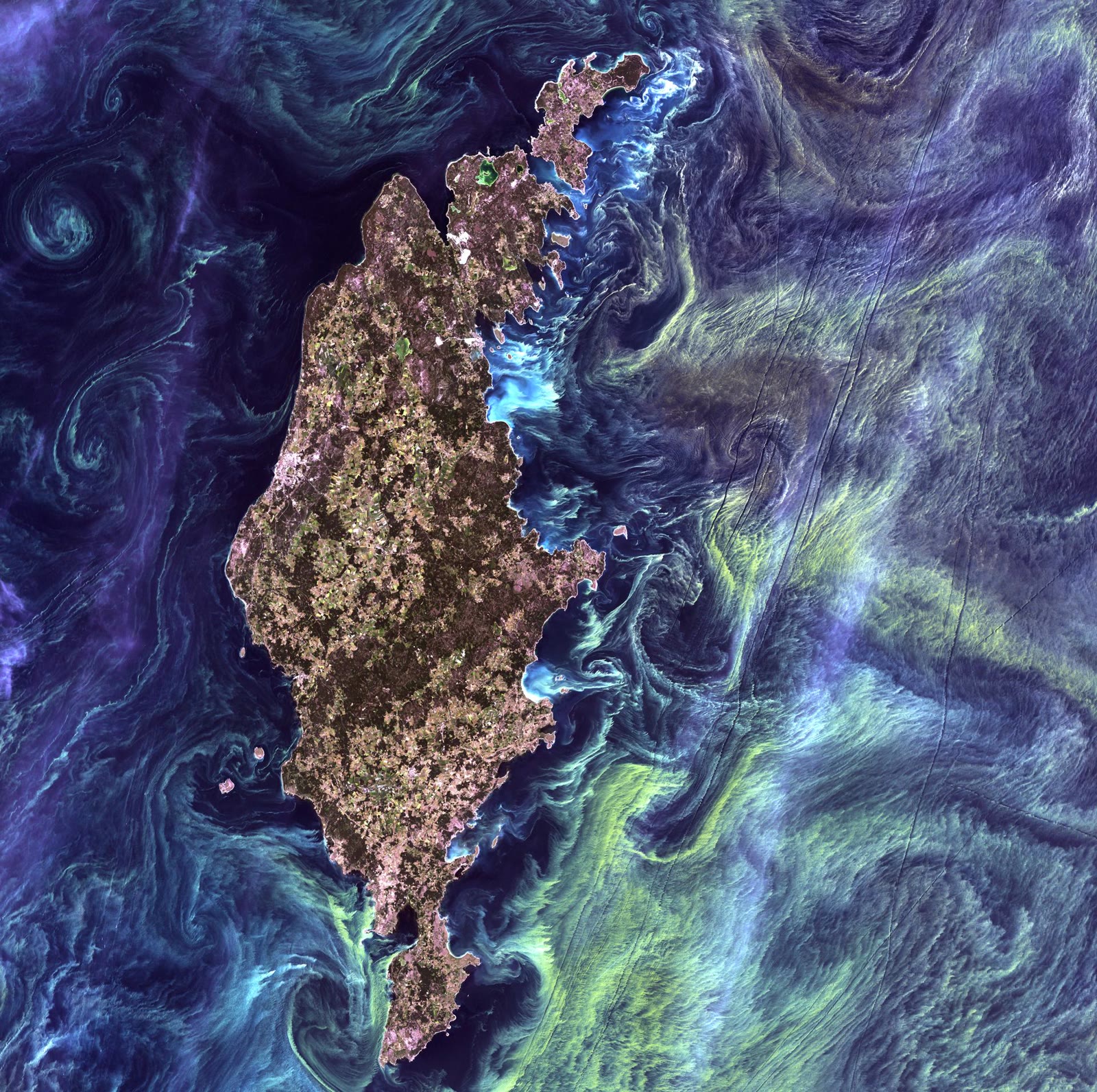
In large stretches of the Southern Ocean and other high-nitrate, low-chlorophyll waters, phytoplankton growth is limited by available iron. Add a little dissolved iron and, under the right conditions, a bloom can follow. That idea — and the hope that bloom carbon might sink and stay sequestered — drove a series of open-ocean iron fertilization (OIF) experiments.
Typical additions were soluble iron salts (commonly ferrous sulfate) released into the mixed surface layer over tens to hundreds of square kilometers — not dumping solid “metal piles” onto the abyssal floor. Concentrations targeted nanomolar dissolved iron in the patch; the physical object of the experiment was a fertilized water mass tracked by ship, not a seafloor metal deposit.
The European Iron Fertilization Experiment (EIFEX, 2004) fertilized a mesoscale eddy in the Southern Ocean and followed the bloom for about five weeks. A diatom-dominated bloom peaked, then several diatom populations underwent mass mortality and formed rapidly sinking mucilaginous aggregates. Smetacek et al. (Nature, 2012) concluded — with stated uncertainties — that at least half the bloom biomass sank below 1,000 m, with a substantial portion likely reaching the seafloor (~3,700 m in related EIFEX ecological reports). That is sinking algal biomass and carbon export, not a reported mass fish kill.
LOHAFEX (Indian–German, 2009) also added iron sulfate in the Southern Ocean, but in low-silicic-acid waters. The bloom was smaller-celled and non-diatom dominated; copepod grazing and amphipod predation tightly controlled biomass. Multiple lines of evidence (sediment traps, thorium, particle imaging) found little fertilization-driven downward particle flux despite higher net community production — see Martin et al. (Global Biogeochemical Cycles, 2013) and AWI overviews. Again: ecology controversy and carbon-export disappointment, not a documented fish die-off.
Deep-sea mining for polymetallic nodules, sulphides, or crusts would disturb metal-rich sediments and rock and can generate suspended particle plumes — at the seafloor and, in some designs, as midwater discharge of processed effluent. That is a different chemistry and a different exposure pathway than nanomolar dissolved iron at the sunlit surface. Related land-side literacy: ore mining & lithium.
Carreiro-Silva et al. (Frontiers in Marine Science, 2022) exposed the habitat-forming cold-water octocoral Dentomuricea aff. meteor to suspended polymetallic sulphide (PMS) particles ground from inactive chimney rock (Lucky Strike), with a quartz-particle arm to separate mechanical from toxicological effects. Dissolved cobalt, copper, and manganese rose in the PMS treatment as sulphides oxidized. Corals accumulated particles, showed tissue necrosis and copper bioaccumulation, and physiological stress markers. Mortality under PMS rose to 36% by day 13, 80% by day 20, and 95% by day 25; by day 27 all fragments were dead or sampled. Inert quartz caused cellular stress and paling but not that mortality pattern over the same window.
ACS Environmental Science & Technology (2025) tested Clarion–Clipperton Zone (CCZ) and North Pacific abyssal sediment particles on the model copepod Tigriopus californicus (and related phytoplankton assays). Copepod survival fell in a dose-dependent way across ~2–50 mg L−1 particle exposures over 26 days; mating pairs, gravid females, and newborns collapsed relative to controls under abyssal sediment exposure. Authors point to ingestion, poor nutritional quality of particles, reduced feeding, and metal toxicity. Surface-water model species, mechanistic relevance for pelagic discharge debates — not a claim that every deep-sea copepod species was tested in situ.
Whole-effluent toxicity work on the aqueous fraction of deep-sea mining effluent (sediments removed) has used standard marine vertebrate and invertebrate models, including sheepshead minnow and inland silverside alongside mysid shrimp and rotifers. In a Clarion–Clipperton Zone–focused investigation, roughly a quarter of DSM samples produced statistically significant reductions in survival (e.g. inland silverside, rotifers) or growth (e.g. sheepshead minnow, mysids). Toxicity did not simply track dissolved copper or zinc alone — other contaminants may matter. See the University of Maryland DRUM deposit: Investigating toxicity of deep-sea mining effluent…. These are lab assays on model fish, not open-ocean kill counts — but they are where “fish died / grew less” language has published footing.
PMC12592452 / Nature Communications (2025) argues that proposed midwater discharge of mining waste can dilute the natural >6 µm particle base of zooplankton and micronekton food webs with nutritionally poor mining-associated particles. With large shares of taxa as particle feeders or zooplanktivores at proposed discharge depths, the paper frames bottom-up disruption risk extending toward larger predators — stress, suffocation, and toxic-metal exposure listed as additional concerns. This is food-web risk analysis more than a single tank mortality trial; it belongs in the “harm pathways” column nonetheless.
Ore mining & lithium — land-side grade, process, and env/social literacy. Atmosphere — layers and climate stakes that make carbon-cycle experiments politically hot. Science status — nanomaterials, robotics, space context. Power — values desk for natural systems.
Disclaimer. Educational overview only. It is not environmental consulting, investment advice, or regulatory guidance, and it does not endorse ocean iron fertilization or deep-sea mining. Lab and mesoscale results do not automatically scale to industrial operations. Prefer the primary papers and agency documents linked above over secondhand summaries — including this one — when stakes are high.